
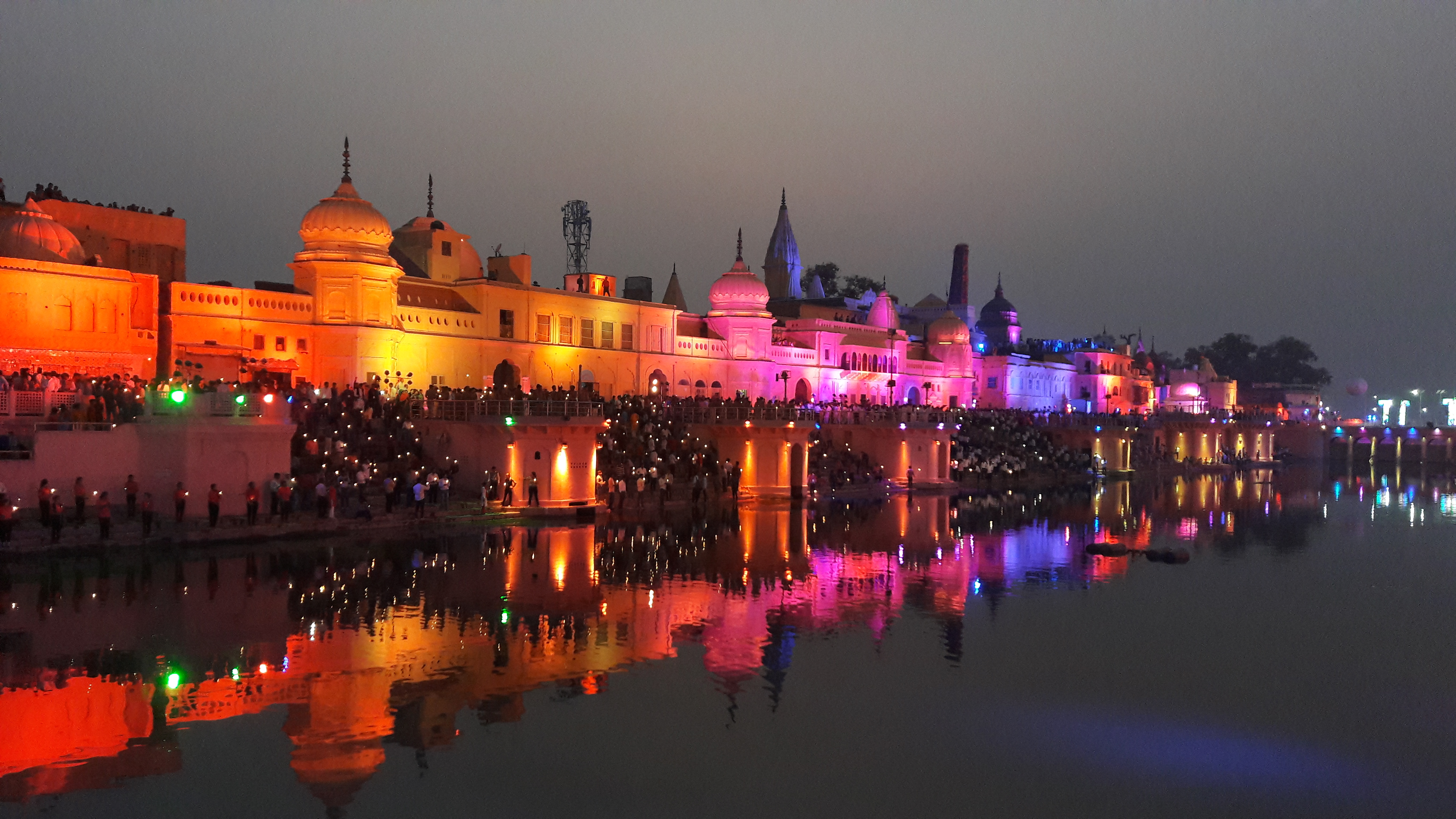

Ayodhya is among the most sacred cities in Hindu tradition and one of the oldest continuously inhabited cities in India. Its significance stretches from ancient scriptural accounts through to January 22, 2024 — the consecration of the Ram Mandir. For a concise chronological timeline from antiquity to the present, see Ayodhya Timelines. This page gives the narrative and context.
Ayodhya in the Ramayana Tradition
The Valmiki Ramayana describes Ayodhya as the capital of the Kosala Kingdom, ruled by the Ikshvaku dynasty. It was presided over by King Dasharatha, and it was here that his four sons — Ram, Lakshmana, Bharat, and Shatrughna — were born. Ram, the seventh avatar of Lord Vishnu according to Vaishnava tradition, is the central figure of the Ramayana epic.
The Ramayana narrates Ram’s birth in Ayodhya, his education, his marriage to Sita in Janakpur, and then his exile to the forest for fourteen years — an act of obedience to his father’s promise, which he accepted without complaint. His return to Ayodhya after defeating the demon king Ravana and rescuing Sita is celebrated annually at Diwali. TRADITIONAL/SCRIPTURAL: These accounts are drawn from the Valmiki Ramayana and the Ramcharitmanas of Tulsidas — sacred texts accepted as authoritative within the tradition; their events are not independently dated historical occurrences.
The sacred Sarayu river, which flows through Ayodhya, is the river on whose banks the city’s entire religious life is centred. Pilgrims bathe in the Sarayu as an act of purification. At the end of Ram’s earthly sojourn, tradition holds that he and his followers entered the Sarayu and returned to the divine realm.
Ayodhya as a Historical City
Beyond its role in the Ramayana, Ayodhya has a documented history spanning over two and a half millennia. The city, also known in ancient sources as Saketa, appears in Buddhist and Jain texts from around the 6th century BCE as a major urban centre. The Buddha is said to have visited the region; Jain tradition holds that five Tirthankaras were born in Ayodhya. Archaeological remains in the region support the existence of a large and prosperous city during this period.
During the Gupta Empire (4th–6th century CE), Ayodhya was a prominent centre of Sanskrit learning and Hindu temple culture. The Chinese traveller Xuanzang (Hiuen Tsang) visited in the 7th century CE and recorded a city with a substantial population, many Buddhist monasteries, and active Hindu temples.
Medieval Period and the Janmabhoomi Dispute
The medieval history of Ayodhya is inseparable from the dispute over the Ram Janmabhoomi — the site believed to be Lord Ram’s birthplace. In 1528 CE, the Mughal commander Mir Baqi, under orders from Emperor Babur, built the Babri Masjid at the site. VERIFY: The claim that the mosque was built after destroying a pre-existing temple at this location is contested between different historical and legal interpretations — the Supreme Court of India addressed this question in its 2019 verdict.
Over the following centuries, Hindu devotees continued to associate the site with Ram’s birthplace and to worship there, despite varying restrictions at different periods. Multiple local attempts to reclaim the site are recorded in historical accounts from the 18th and 19th centuries. In 1853 the first major communal disturbance over the site occurred; in 1859 British colonial authorities divided the premises by erecting a barrier.
In 1949, idols of Ram Lalla were found inside the mosque. The site was placed under lock and key by court order. Decades of legal proceedings followed.
The Supreme Court Verdict and Ram Mandir
On November 9, 2019, the Supreme Court of India delivered a unanimous verdict in the Ram Janmabhoomi case. The court awarded the disputed 2.77 acres to the Ram Janmabhoomi Nyas (trust) for construction of a Hindu temple, and directed the government to provide a separate 5-acre plot to the Sunni Waqf Board for a mosque.
The ground-breaking ceremony (bhumi pujan) was performed by Prime Minister Narendra Modi on August 5, 2020. Construction proceeded over the following years under the aegis of the Shri Ram Janmabhoomi Teerth Kshetra Trust.
On January 22, 2024, the consecration ceremony (Prana Pratishtha) was performed, with Prime Minister Modi installing the idol of Ram Lalla (child Ram) in the new temple. The ceremony was watched by an estimated 500 million people in India and around the world, and marked the culmination of a movement that had lasted generations. VERIFY: The 500 million viewership figure is widely reported but has not been independently audited.
Ayodhya Today
The opening of the Ram Mandir has transformed Ayodhya. Millions of pilgrims visit each year. New infrastructure — the Maharishi Valmiki International Airport, Ram Path boulevard, Sarayu ghats development — has reshaped the city for mass pilgrimage. For current infrastructure and development details, see Ayodhya City Update.
For devotees, Ayodhya holds a simple and profound significance: it is the birthplace of Ram, the city from which he went into exile and to which he returned in triumph, and the place where his story continues to be lived and celebrated every year.
Related Pages
- Ayodhya Timelines — concise chronological reference from ancient times to 2024
- Ram Mandir Ayodhya — the Ram Mandir: significance, key facts and visiting guide
- Hanuman Garhi Ayodhya — the first temple every pilgrim visits
- Birth of Hanuman — the story of Hanuman’s birth and its connection to the Ramayana setting
- Ayodhya City Update — current development and infrastructure
Jai Shri Ram! Jai Ayodhya!