
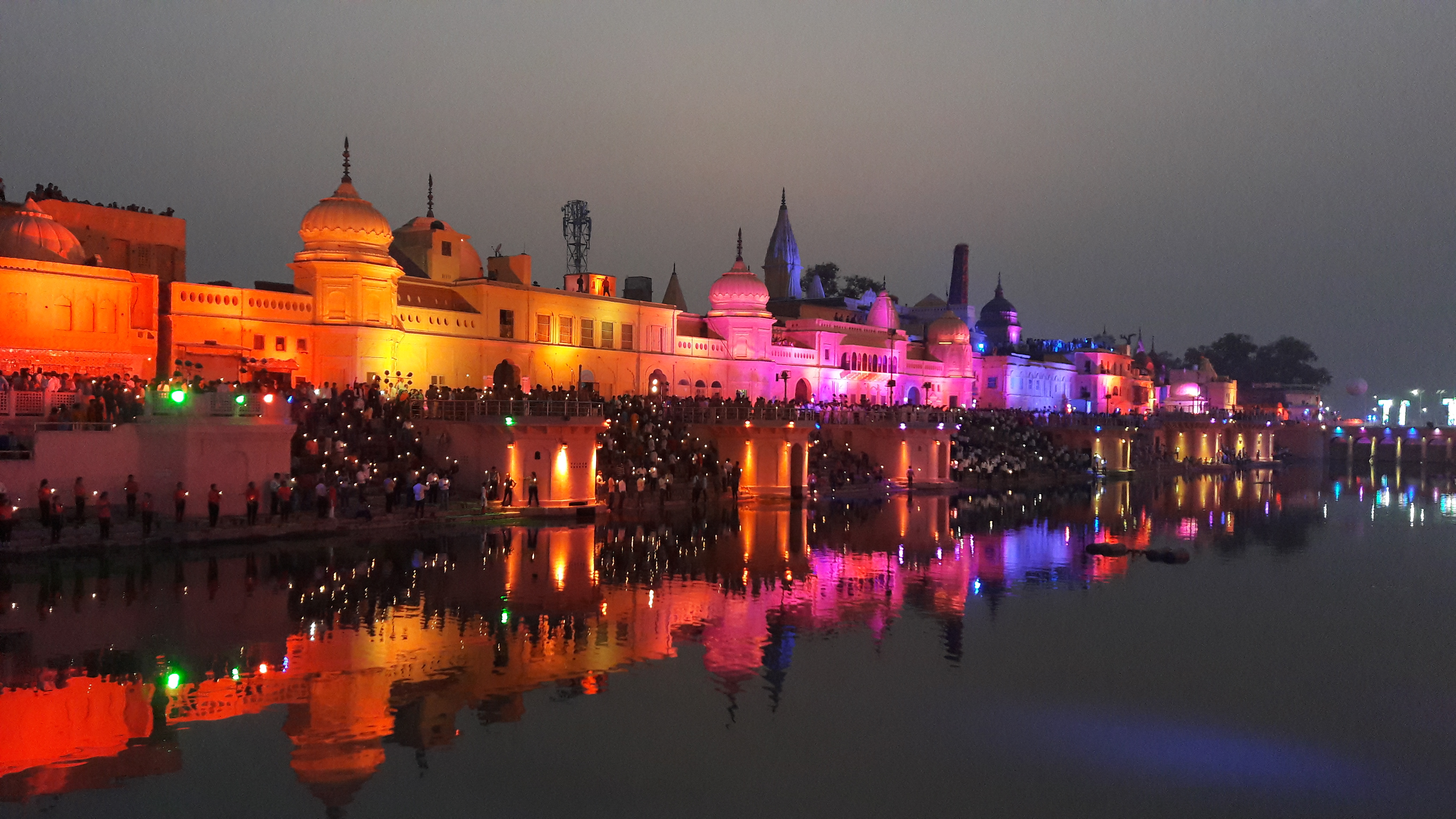
Ayodhya is one of the oldest living cities in the world. Its history spans from the age of the gods through ancient empires, medieval kingdoms, Mughal rule, colonial India, and into the 21st century. For the narrative history and context, see Ayodhya History. This page is the concise chronological reference.
Ancient Era — The Age of Ram
- Treta Yuga (ancient, traditional dating): According to Hindu tradition, Ayodhya is the birthplace of Lord Ram, seventh avatar of Lord Vishnu. The Valmiki Ramayana describes it as the magnificent capital of the Kosala Kingdom, ruled by the Ikshvaku dynasty. Ram’s father Dasharatha held court here. TRADITIONAL/SCRIPTURAL: The Treta Yuga is a period within the Hindu cosmological time cycle; it does not correspond to a specific date in the common era calendar. Claims of “7,000 years ago” or similar figures are traditional belief, not established archaeology.
- Post-Ram era: According to Puranic accounts, the city was ruled by Ram’s sons Luv and Kush and continued as a great kingdom for many generations.
Historical Era
- ~6th century BCE: Ayodhya (also known as Saketa) is mentioned as a major urban centre in Buddhist and Jain texts. The Buddha is said to have visited the region. Jain tradition holds that five Tirthankaras were born in Ayodhya. VERIFY: The identification of ancient Saketa with modern Ayodhya is widely accepted but has been subject to scholarly discussion.
- ~3rd century BCE: The Maurya Empire under Ashoka; Buddhist monasteries were established in the region.
- 1st–4th century CE: The Gupta Empire. Ayodhya flourishes as a centre of Sanskrit learning and Hindu temple culture.
- 7th century CE: Chinese traveller Xuanzang (Hiuen Tsang) visits and records Ayodhya as a large city with Buddhist monasteries alongside active Hindu temples.
Medieval Era
- 11th–12th century CE: Multiple invasions from Central Asia. Temples in the region suffer repeated destruction.
- 1528 CE: The Babri Masjid is built by Mughal commander Mir Baqi on the orders of Emperor Babur at the site believed to be Ram’s birthplace. VERIFY: Whether an earlier temple was demolished to build the mosque is contested between different historical and legal interpretations. The Supreme Court’s 2019 verdict acknowledged the Hindu belief in Ram Janmabhoomi but did not make a conclusive finding on demolition.
- 16th–19th century: Hindu devotees continue to worship at the site in various forms. Multiple local uprisings and disputes over the Janmabhoomi are recorded in historical accounts.
Modern Era
- 1853: First recorded major communal disturbance over the Janmabhoomi site.
- 1859: British colonial administration erects a barrier dividing the site — Muslims pray inside, Hindus in the outer courtyard.
- 1949: Idols of Ram Lalla appear inside the Babri Masjid. The site is locked by order of the district magistrate.
- 1986: Courts order the locks opened; Hindu worship permitted inside.
- December 6, 1992: The Babri Masjid structure is demolished by a large crowd. The event triggers nationwide riots and deaths.
- November 9, 2019: The Supreme Court of India delivers a unanimous verdict: the disputed 2.77 acres are awarded to the Ram Janmabhoomi Nyas for temple construction. A separate 5-acre plot is awarded to the Sunni Waqf Board for a mosque elsewhere in Ayodhya.
- August 5, 2020: Prime Minister Narendra Modi performs the bhumi pujan (ground-breaking ceremony) for the Ram Mandir.
- January 22, 2024: Ram Mandir consecration (Prana Pratishtha). PM Modi installs the idol of Ram Lalla (child Ram) in the completed inner sanctum. The ceremony is watched by hundreds of millions across India and around the world. VERIFY: The specific viewership figure (reported as 500 million+) is widely cited but not independently audited.
Related Pages
- Ayodhya History — narrative and context for the events in this timeline
- Ram Mandir Ayodhya — the Ram Mandir today: key facts, darshan and visiting guide
- Hanuman Garhi Ayodhya — Hanuman’s temple in Ayodhya
- Ayodhya City Update — current development and infrastructure
Jai Shri Ram! Jai Ayodhya!