
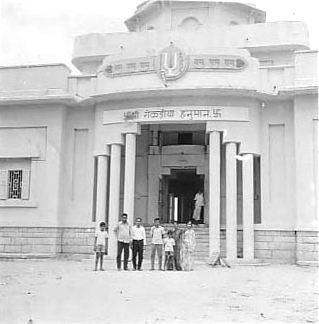
In the town of Porbandar (also known historically as Sudawapuri) in coastal Gujarat, a
rare eleven-faced form of Hanuman is enshrined within the Shri Panchmukhi Mahadev temple
complex. Known as Ekadashi Mukhi Hanuman — “ekadasha” meaning eleven in
Sanskrit — this murti presents Hanuman with eleven faces, twenty-two arms, and two feet,
making it an unusually elaborate iconographic form.
The Temple at Porbandar
The Ekadashi Mukhi Hanuman shrine is located inside the Shri Panchmukhi Mahadev temple
in Sudawapuri, Porbandar, Gujarat. (REGIONAL/TRADITIONAL ACCOUNT — the association of
“Sudawapuri” specifically with Porbandar is a local tradition; the name Sudawapuri does not
appear uniformly in published geographical sources and should be verified.)
The placement of an Ekadashi Mukhi Hanuman within a Panchmukhi Mahadev temple reflects
the close devotional relationship between Hanuman and Shiva — in several Hindu traditions
Hanuman is regarded as an avatar or partial manifestation of Shiva.
(TRADITIONAL/SCRIPTURAL — the Hanuman-as-Shiva-avatar belief varies by sampradaya and
is not universally accepted across all Vaishnava traditions.)
The Eleven Faces — Form and Significance
The eleven faces of this murti, described in the temple tradition, are:
- Kapi Mukh (Vanar Mukh) — Hanuman’s primary monkey face, representing
his natural form as the devoted servant of Sri Ram. - Bhairav Mukh — the fierce aspect associated with Shiva’s protective
and destructive power. - Agni Mukh — the fire face, representing purification and the
transformative power of fire. - Mayagreev Mukh — (FACT-CHECK FLAG: Mayagreev is the name of a
demon king in some Ramayana traditions; this face requires source verification — it is
unusual for a demonic name to appear in a list of Hanuman’s divine faces.) - Varaah Mukh — the boar face, the form of Vishnu’s third avatar
(Varaha), who lifted the earth from the cosmic ocean. - Naag Mukh — the serpent face, associated with cosmic protection and
the Nagaraja tradition. - Rudra Mukh — the aspect of Rudra, the fierce form of Shiva.
- Narsing Mukh (Narasimha Mukh) — the man-lion face, the form of
Vishnu’s fourth avatar who destroyed Hiranyakashipu. - Gaj Mukh — the elephant face. (FACT-CHECK FLAG: Gaj Mukh is
most commonly associated with Ganesha; its inclusion here as a face of Hanuman is
unusual and should be verified against the temple’s iconographic tradition.) - Saumya Mukh — the serene, benign face representing Hanuman’s
gentle and compassionate aspect as a boon-giver and protector of devotees. - Garuda Mukh — the eagle face of Garuda, the vehicle of Vishnu and
enemy of serpents, representing swiftness and divine power.
Together these faces span multiple divine traditions — Vaishnava avatars (Varaha,
Narasimha, Garuda), Shaiva forms (Bhairav, Rudra), elemental forces (Agni, Naag), and
Hanuman’s own primary form. This kind of composite multi-faced iconography is characteristic
of tantric traditions in which a single deity is understood to encompass all divine powers.
(TRADITIONAL/BELIEF — this interpretation reflects one theological framework; other
traditions may describe the significance differently.)
Ekadashi Mukhi Versus Panchmukhi
The more widely known multi-faced form of Hanuman is the
Panchmukhi (five-faced) form, in which Hanuman faces
five directions simultaneously to protect Sri Ram and Lakshmana in the Ramayana. The
Ekadashi Mukhi form extends this cosmic scope to eleven faces, each guarding a greater range
of directions and spiritual forces. Both forms express the theological idea that Hanuman’s
protective power is universal and all-encompassing.
The five faces of the Panchmukhi form — Hanuman, Narasimha, Garuda, Varaha, and Hayagriva
— overlap partially with the Ekadashi Mukhi list; the additional six faces in the Ekadashi
form bring in further divine energies including Shaiva aspects not present in the five-faced
form. (FACT-CHECK FLAG: confirm whether Hayagriva appears in the Panchmukhi list for the
Sarangpur form specifically, as face lists vary by region and tradition.)
Hanuman in Gujarat — Related Temples
Gujarat has a strong Hanuman devotional tradition. The most celebrated Hanuman temple in
the state is
Shri Hanuman Mandir, Sarangpur, where the
presiding form is the powerful Kastabhanjan (destroyer of sorrows) Hanuman. The Sarangpur
murti is also a multi-armed form and among the most visited Hanuman shrines in India.
For an overview of major Hanuman temples and sacred sites, see the
Hanuman Ji Temples page.
Devotional Practice
Devotees visiting the Porbandar temple typically offer prayers in the manner common to
Hanuman shrines across Gujarat — recitation of the
Hanuman Chalisa, offering of sindoor (vermilion), and
recitation of Hanuman mantras. Tuesdays and Saturdays are
considered especially auspicious for Hanuman worship across traditions.
(TRADITIONAL/BELIEF — the specific practices at this temple should be verified with the
temple directly, as local customs may differ.)
For those who observe Hanuman worship in relation to planetary influences, see
Hanuman and Astrology for the traditional role of
Hanuman in Saturn and Mars-related practices.
Jai Ekadashi Mukhi Hanuman Ji — Jai Shri Ram.