
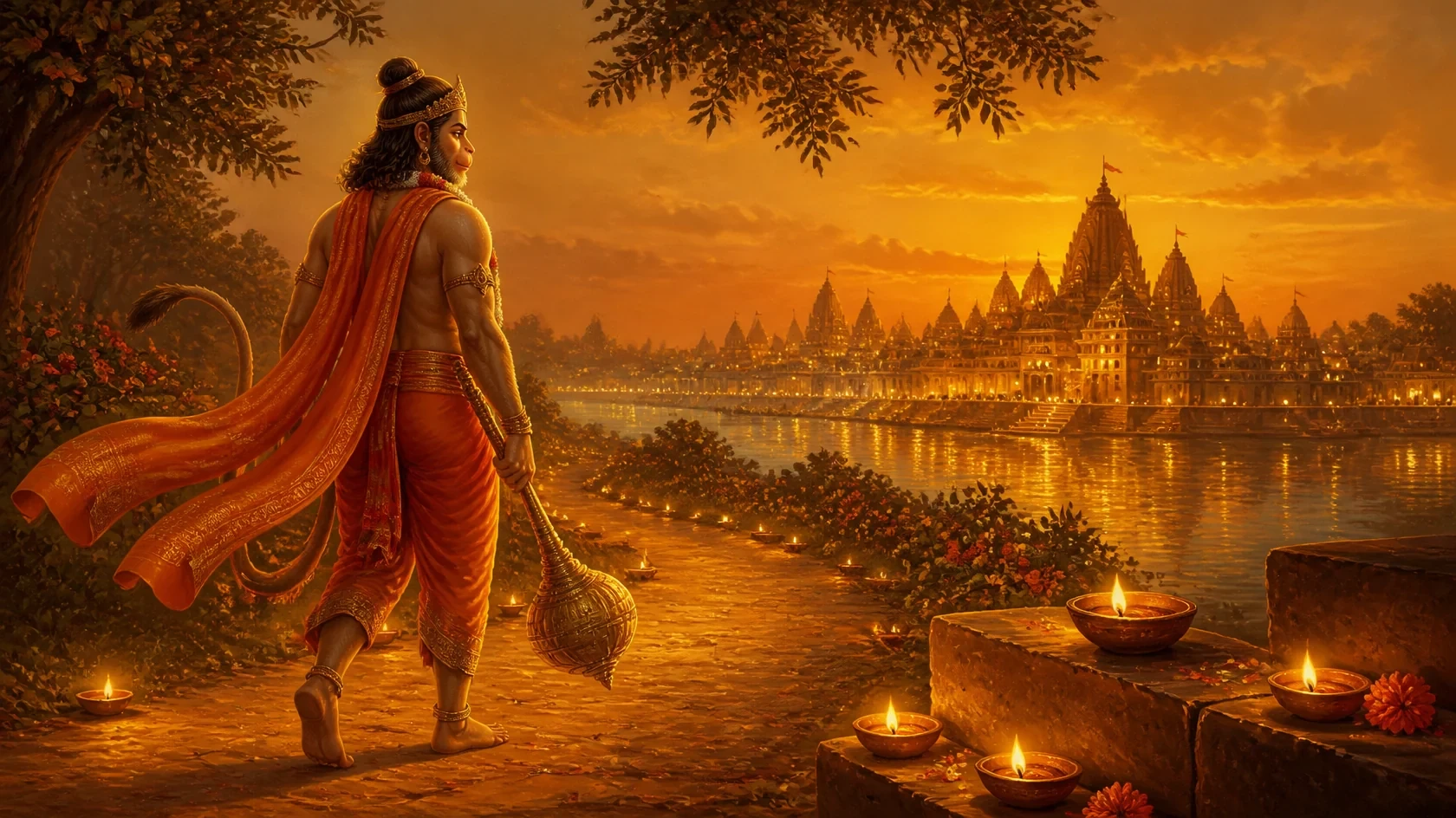
A careful reading of the Valmiki Ramayana and a devotional reflection for Diwali
When devotees remember Shri Ram’s return to Ayodhya, Hanuman Ji is naturally remembered with Him. His whole life is offered at Shri Ram’s feet. Yet the Valmiki Ramayana gives a particular and moving answer to the question of where Hanuman Ji was at that decisive moment: before Shri Ram entered Ayodhya, Hanuman Ji was sent ahead in service, carrying the news of His return.
This is a beautiful connection for a Diwali reflection, but it deserves to be told carefully. The Valmiki Ramayana records Hanuman Ji’s message to Guha and Bharata. It does not name Diwali in this passage, describe rows of lamps in Ayodhya, or say that Hanuman Ji lit diyas. The festival’s welcome of Shri Ram with lamps belongs to later devotional and cultural remembrance. Honouring both the scripture and the living tradition allows the story to shine more clearly.
What the Valmiki Ramayana says
In the Yuddha Kanda, Shri Ram is nearing Ayodhya after the long exile and the victory over Ravana. Looking toward Ayodhya, He calls Hanuman Ji and asks him to go swiftly ahead. Hanuman Ji is to visit Guha at Shringaverapura, learn the way and news of Bharata, and then carry Shri Ram’s message to Bharata.
Shri Ram tells Hanuman Ji to report that He is returning with Sita Ji and Lakshmana Ji, that His purpose has been accomplished, and to tell the events of the journey and the war. He also asks Hanuman Ji to observe Bharata’s disposition and intention, and to return quickly with what he learns. The passage presents Hanuman Ji not as a spectator of the approaching homecoming, but as the trusted messenger entrusted with a delicate and loving duty.
Hanuman Ji assumes a human form and sets out swiftly. After meeting Guha, he continues to Nandigrama, where Bharata is living in austerity while awaiting Shri Ram’s return. There Hanuman Ji gives the news: Shri Ram is on His way, Sita Ji and Lakshmana Ji are with Him, and the long separation is ending.
Bharata’s response is profound. On hearing Hanuman Ji’s words, he is overcome with joy. The text describes him falling unconscious from happiness, then recovering, speaking with Hanuman Ji, and embracing him with tears of love. Hanuman Ji’s message becomes the bridge between Bharata’s long vigil and the brothers’ reunion.
Where was Hanuman Ji
At the point just before Shri Ram’s arrival, Hanuman Ji was on the road of service. He had been sent ahead from the returning party, first to Guha and then to Bharata. In the narrative, he is not described as arranging Ayodhya’s welcome. He is carrying Shri Ram’s words, confirming Bharata’s readiness, and bringing the long-awaited news of reunion.
That answer is simple, but it is full of meaning. Hanuman Ji’s joy is not separate from service. Even at the threshold of Ayodhya, after the great work of the war is complete, he is ready for the next command. The moment is not presented as a pause for honour; it is another act of faithful devotion.
What later devotional memory adds
For many devotees, Diwali is the joyful remembrance of Shri Ram’s return to Ayodhya and the welcome offered to Him. Lamps, prayer, hospitality, and the celebration of light are cherished parts of that remembrance across homes and communities. These customs carry deep devotional meaning, even when a particular detail is not narrated in this passage of the Valmiki Ramayana.
It is therefore better to say that Hanuman Ji is remembered at Diwali because his devotion to Shri Ram is inseparable from the story of Shri Ram’s return. It is not accurate to say that the Valmiki Ramayana states that Hanuman Ji lit the lamps of Ayodhya. A devotional tradition can be loved without turning it into a scriptural quotation.
A devotional reflection
Hanuman Ji’s journey ahead to Bharata offers a quiet way to approach Diwali. When good news is near, he does not place himself at the centre. He carries the message of Shri Ram. When reunion is possible, he helps make the path ready. When Bharata’s heart is burdened by separation, he brings the words that restore hope.
This is devotional interpretation, not an event added to the text. It invites us to see in Hanuman Ji the spirit of seva: to carry what is true with humility, to prepare the way for what is good, and to rejoice when love and dharma are restored.
As lamps are lit in a home, a devotee may remember this service of Hanuman Ji: not a claim that he lit those lamps, but a remembrance that he carried the light of Shri Ram’s return into Bharata’s waiting heart.
A simple Diwali remembrance
On Diwali, after lighting a diya or sitting quietly for prayer, one may remember Hanuman Ji with these thoughts:
- May I serve without seeking a place for myself.
- May I carry words that bring truth, comfort, and hope.
- May my devotion remain turned toward Shri Ram, as Hanuman Ji’s devotion always was.
- May the light I welcome be joined with humility, remembrance, and seva.
A short prayer
Shri Hanuman Ji, faithful servant of Shri Ram, teach us the joy of humble service. As you carried the news of Shri Ram’s return to Bharata, carry remembrance of Shri Ram into our hearts. May our Diwali be filled with devotion, gratitude, and the light of dharma. Jai Shri Ram. Jai Hanuman.
Source and approach
The narrative basis for this article is the Valmiki Ramayana, Yuddha Kanda, Sarga 125 in the Southern recension and Gita Press-style numbering, especially verses 6.125.3-19 and 6.125.29-42. These verses describe Shri Ram sending Hanuman Ji ahead, Hanuman Ji’s journey to Guha and Bharata, and Bharata’s response to the news. Sarga and verse numbering can differ across editions and recensions; readers should consult the numbering of their own edition.
For accessible English reading, the article was checked against the Sanskrit Documents presentation of Yuddha Kanda Sarga 125 and a verse-by-verse translation. The devotional reflection is clearly marked as interpretation. No claim is made that this passage names Diwali, describes the lighting of diyas in Ayodhya, or says that Hanuman Ji lit them.